Sabah's lost world
By Steve White
Photos: Steve White, Jason Isley / Scubazoo.com
Evocative story of discovery? Check. In 1947, the Borneo Bulletin newspaper reported that a light plane surveying the area on a cloudy day, nearly flew straight into high cliffs that veered up into view unexpectedly.
Remote and uninhabited? Check. It's halfway across Sabah, far from the vastly more populous coasts, almost up against the border with Indonesia's North Kalimantan province. Devoid of flat land, riddled with almost fishless rivers, the basin bears no signs of ever having any permanent settlements.
Weirdly shaped? Check. While it's no Skull Island, those cliffs, rearing hundreds of metres above the basin, arc round to create what looks like a giant elephant's footprint in the jungle, 25km across.
Doing some quick homework en route to Sabah, I pulled up the all-seeing app, Google Earth. Today, this tool to hand, no one would be surprised to find those cliffs, and clearly roads and villages lie within 10-20 kilometres in every direction. That darker circle of forest in the middle remains compelling though. There surely must be something to the Maliau's impenetrability, I thought, if even Google hasn't got much on it.
Though its shape suggests the product of a meteor strike, or a volcanic caldera, the truth is less dramatic. Esoteric processes of folding, faulting and erosion have created a vast bowl, tilted to the southeast, within which lies what the Murut tribe of the area call the 'Land of Giant Staircases'. That's due to alternate hard and soft layers of underlying rock that have given the basin an extraordinary profusion of waterfalls - many still unnamed. All these drains into a single river, also called the Maliau, which flows off to join the Kinabatangan River, Sabah's longest.
The largest of all the falls is Maliau Falls, a multi-tiered spectacle that is the focal point of the usual four-day hike: a three-day triangle of trails, with an extra day spliced in for the tricky there-and-back to the falls. It's marketed as a challenge, a sort of elongated Mt. Kinabalu, the view and a dip in its waters payoff for enduring an arduous approach. Knowing that the best views of the falls require a helicopter, and that anyway, the water levels were low, I realised the hike itself would be my highlight.
After a long drive from the coast, we turned into the Maliau Basin Conservation Area (MBCA) and onto an access road in the midst of a radical upgrade. Paid for with federal funds, it replaces what was a precarious logging track. Soon to be paved over its 20-kilometre length, it has generous hard shoulders and parking zones, and a wide swathe of forest has been felled and graded to reduce the risk of landslide.
Speaking to me at the study centre later, MBCA Manager, Jadda Suhaimi, diplomatically pointed out how the wide clearance will allow drivers to see wildlife from much further away, but adds that he is now requesting the addition of animal crossings and traffic-slowing measures. Some animals, like the Borneo banteng, a species of wild cattle wary of roads, are stuck on the wrong side, he says, where they are vulnerable to encroachment from poachers. He also wants to run cables overhead for orangutan and replace some of the lost hardwoods with fruiting trees to bring wildlife to the roadside where guests have more chance to see it.
The studies centre, close to the Maliau River itself, is simple but well maintained. The staff quarters and offices are here, along with a good library, a clutch of lodges for accommodation and a dining hall under which wild pigs grub around every night, slurping down tasty wastewater from the kitchen.
Next morning, my guide Zizul and I jumped a ride out northwest to the trailhead, Agathis Camp at 500m above sea level. There a new park has been laid out, wide enough to drift tour buses, though the camp itself lies ruined, trampled by rampaging elephants.
The camp is named for another species of stately forest giant - a conifer no less - whose ruddy barked trunk can extend 20m or more before the first limbs. Though there were examples around, I was told that one of the best stood behind Nepenthes Camp on the basin rim, our first day's goal.
The trail between was all uphill at first, even deploying ladders over the rockiest sections. Then the gradient backed away and the final kilometres were more rolling as we passed through moss-hung forest with a prehistoric air about it.
Nepenthes sat at a touch over 1,000m at the top of a small clearing, but the money view came from a platform, cradled 30m higher, in the first limbs of that gigantic agathis I'd been promised. It was a nervy climb, straight up, that Zizul admitted he'd never done, having been put off heights since breaking a shoulder falling from a coconut palm. But once up, the aerie was perfect for catching the breeze, with only epiphytes and ants for company.
The camps in Maliau are not permanently staffed - each group is followed up by a cook carrying supplies - but Nepenthes has a lodger, nonetheless. That evening I was sat with a cup of 'tea' - the river water is so tannin-rich you needn't use a bag - and a surprisingly seafoody dinner, when a marvellously dappled shadow slipped out into the pool of light: a Malay civet. I was conflicted. He is clearly being fed by the guides, but it was a joy to be so close as this pedigree specimen ran through his housecat shtick, only stopping short of letting me touch.
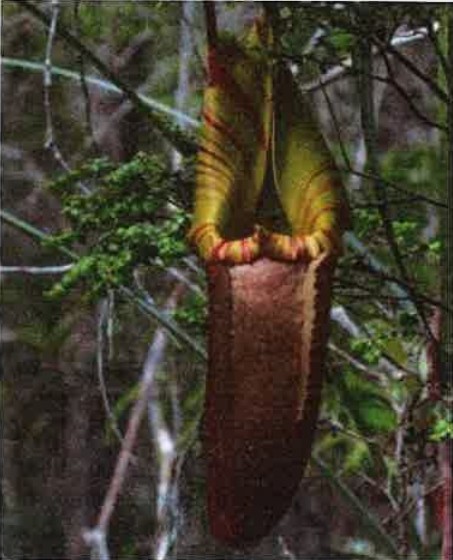
After a sunrise atop the agathis, we set out again next morning, soon reaching the distinctive heath forest. This is a key feature of the basin, fantastically intact and little visited, where bizarre plants hold sway, chief among them multiple species of carnivorous Nepenthes: pitcher plants.
Unlike on Mt. Kinabalu, where hikers are obliged to turn off the trail for a look at a few sorry stragglers, here they literally grow on trees. Tendrils of Nepenthes veitchii coiled up to head height and more, clasped tightly to their hosts. Within metres, we found spiny hirsuta and curvaceous reinwardtiana, while almost lost on the ground were the minute upturned bells of tentaculata.
I slowed to take it in, the boggy ground sucking at me as though to still my feet so I could become another erect form up which the creepers could clamber. Though the bright sunlight did its best, there was a dark fascination to the place: a habitat where most of the plants eat animals to survive.
Pulling myself away, we hiked on, coming next to a long ridge. Here the taller trees offered perfect 360 degrees lookout posts against predators so we took our time and were rewarded with the hosts of gibbons and then the honk of hornbills.
There they were, in a tree right on the rim's edge, helmeted hornbills. We watched several pairs squabbling, then more swooped in until we had maybe 20 in front of us in all their raucous glory.
Zizul thought he'd spotted a silver leaf monkey so we edged forward. Our movement flushed out two red leaf monkeys instead who sounded the alarm. The game was up. As we tracked their escape, the hornbills took wing and a squirrel darted up the limb of a neighbouring tree. Like a stone dropped in a pond, we had sent a ripple through the forest and there was nothing for it but to walk on.
A little further along, around 4.5km from Nepenthes Camp, we scaled a high point from where a trail headed off into the interior: "a hard trail" was Zizul's judgement. I gazed that way. I knew several derelict camps lay out there: Rafflessia, not so far off, but then Strike Ridge and Eucalyptus, incredibly up to a week's walk, according to him. Another time, maybe, I thought.
I made the same decision at the Maliau Fall turn. Normally, hikers overnight at the nearby Ginseng Camp (said with a hard 'g' here), then return for the walk in, and a day around, Maliau's centrepiece. I'd already opted to get a day back for better exploration of the area around the studies centre, knowing its lower montane habitat promised different wildlife.
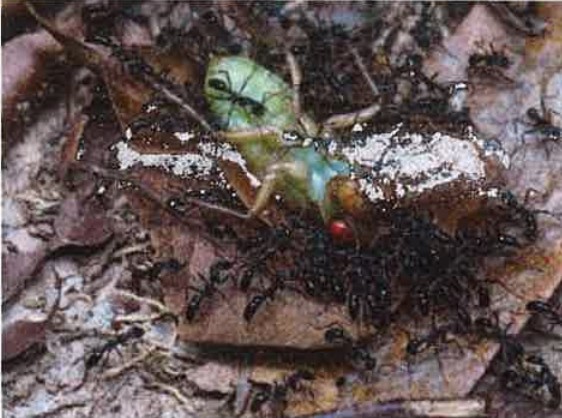
Fire ants ferry off an unfortunate grasshopper
Next day therefore, we climbed out of the valley in which Ginseng sits, and made the long descent to Agathis. We spooked a couple of barking deer on the way and were lucky enough to watch a young mongoose ferreting about in the undergrowth at close quarters, showing a brazenness borne of inexperience.
At lunch I donated some short sections of noodle to fire ants, amused by the Laurel and Hardy antics of a pair who shared a load but couldn't stay in step over the rough ground, their prize twisting round twigs and spinning them about.
After several hours, we reached the red-trunked stand of agathis trees again: the trek was over. I returned to the studies centre to treat my leech bites, look up our sightings and reconnect to the world.
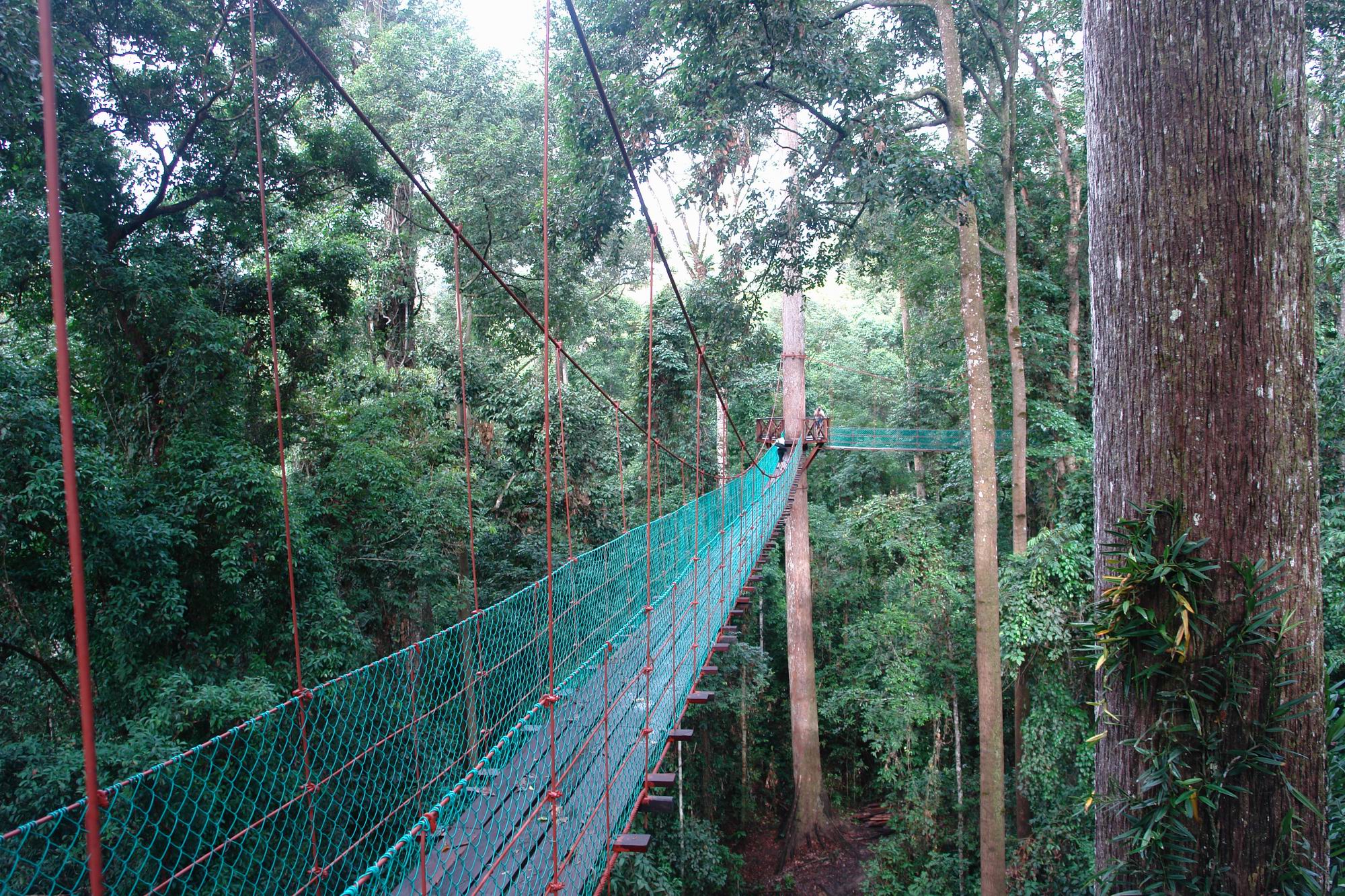
Soothed, enlightened and updated, next day I found another guide to walk me round the area's short nature trails and over the Skybridge, a chain of bridges and platforms ideal for a close-up canopy experience. He showed me a porcupine burrow and the drainage channel where a six-metre python lay for weeks digesting a deer - then I repeated the walk alone in late afternoon, and again my final morning.
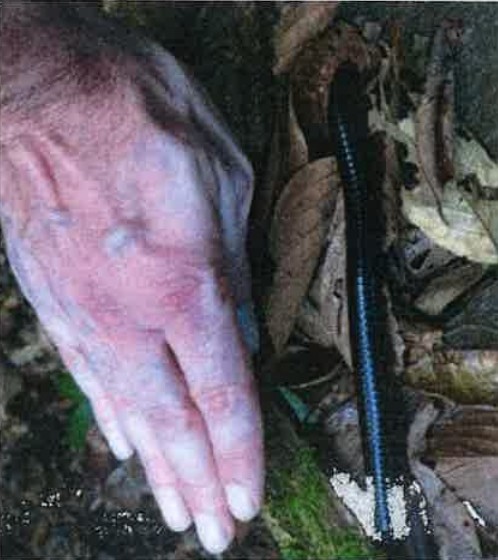
A black millipede on the march
The thrill of potential discovery never gets old, and hiking alone in the forest - even by day and on a recognised trail - sets the nerves jangling with every skittering by your feet, or unrecognised call above your head.
I spotted some long-tailed macaques from the Knowledge Trail (a short, signed loop over the river), though they are common enough around Asia. Far more exciting was finding what were later confirmed as fresh elephant prints in a streambed.
The best chance of seeing bigger mammals here lies in a night drive. Despite the rattle of the truck, animals were regularly caught in the sweep of our guide's flashlight: flying squirrels, two palm civets and numerous sambar deer. Indeed the latter seemed poor judges of relative danger, indifferent to our presence at times.
Right now, Maliau is a backwater compared with Sabah's established wildlife attractions in Danum Valley and the Kinabatangan River. There's talk of a possible zipline and other 'built' activities to draw people in, but the main idea now, according to park authorities, is to plot a manageable but more direct route to Maliau Falls. Then the current triangular hike can stay lightly hiked, for the purist looking for a taste of untouched jungle.
For the more adventurous still, there's the siren call of those lost camps, maybe even that famous escarpment on the towering northern rim. Perhaps one day these objectives will be offered to sufficiently prepared visitors.
As I headed for bed, on the lodge stairs, a young tree snake was making a sinuous escape. In the 'Land of Giant Staircases' this one was puny in the extreme and the snake was soon safely back amid the bushes. I had to hope the same will be true of those banteng and orangutans caught on the wrong side of the studies centre's road.
"We would like to extend our sincere gratitude to Mr Steve White for contributing this insightful piece. Sharing firsthand experiences is vital in helping others understand the unique biodiversity and conservation significance of the Maliau Basin Conservation Area. Thank you for being a part of our story."
From: Conservation & Environmental Management Division, Yayasan Sabah Group, 2017